

U.S. Endowment, Georgia Tech’s Aerospace Systems Design Laboratory Complete Forestry Residues Study
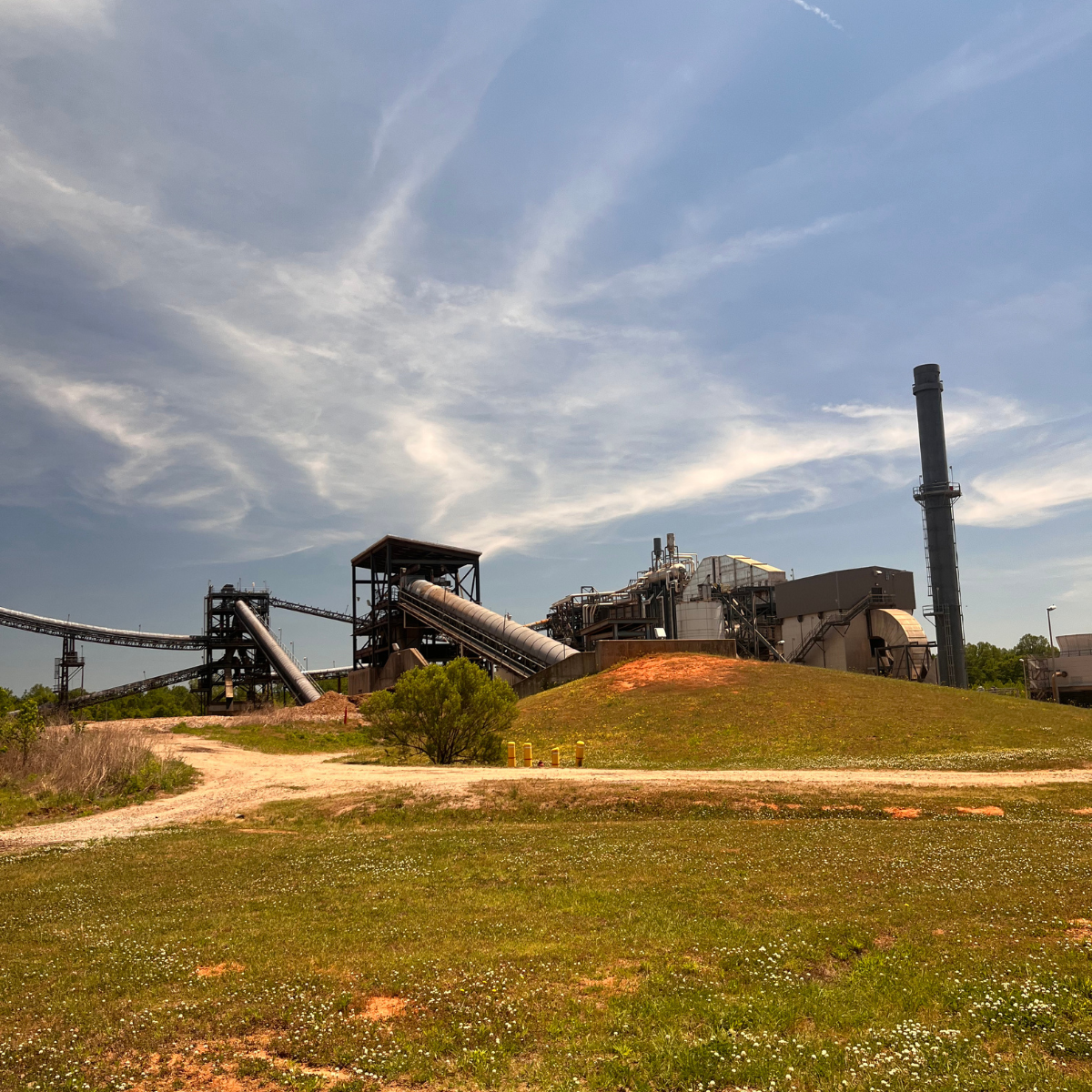
Facilities like this help turn forest and mill residues into marketable products, supporting working forests, rural jobs and the communities that rely on them.

A truck unloads wood fiber at a forest products facility, highlighting the infrastructure that helps move material from working forests into productive use.

The U.S. Endowment works with public and private partners to strengthen healthy forest product markets and the communities that rely on them.
Grand Challenge project identifies biomass power as a strong near-term market for underused forest fiber
Developed through Georgia Tech’s Aerospace Systems Design Laboratory (ASDL), the prototype decision-support tool models how underutilized forestry and mill residues could be converted into biomass power, renewable diesel and sustainable aviation fuel (SAF). The tool allows users to test how choices about feedstock supply, plant location, transportation, financing assumptions, market prices and policy incentives affect project viability.
The work responds to a major shift across the forest sector. Since 2015, more than 40 pulp and paper mills have closed, eliminating an estimated 60 million tons of annual demand for wood fiber from forest regions across the country. A new economic analysis commissioned by the Endowment and conducted by AFRY Management Consulting finds that additional pulp and paper capacity remains at risk in the years ahead.
In the Southeast alone, new markets are needed for roughly 43 million tons of underutilized and residual wood each year. When that fiber loses its market, landowners have fewer financial incentives to thin and manage forests, which can increase wildfire risk, weaken forest health and contribute to land-use change.
“When a paper mill closes, it takes jobs, markets and a community’s confidence with it,” said Pete Madden, president and CEO of the U.S. Endowment for Forestry and Communities. “This work gives us a credible way to show investors and policymakers where new opportunities exist and what it would take to capture them. If it helps bring even one project, and the jobs that come with it, to a community that lost its mill, that’s a win.”
The team presented its findings last month to ASDL’s External Advisory Board meeting and program review, along with Endowment leaders, industry representatives and other stakeholders. Under the modeled scenarios, biomass power showed the strongest near-term potential because it generally requires lower capital investment than liquid fuel production and can use a broader range of feedstocks. Renewable diesel and sustainable aviation fuel showed significant long-term promise but were more sensitive to fuel prices, financing assumptions and policy support.
The tool combines techno-economic analysis with a systems-of-systems approach, a method the ASDL team uses to break large, complex problems into parts that can be modeled and compared. Users can adjust assumptions and evaluate trade-offs in real time, including jobs, emissions, capital costs, operating costs and project economics. That capability allows stakeholders to test scenarios together rather than waiting weeks or months for each new analysis.
“At ASDL, we developed a comprehensive framework to evaluate both the technical performance and economic viability of transforming forestry residues into bioenergy and sustainable aviation fuel,” said Dr. Dimitri Mavris, ASDL director and Regent’s Professor in the Daniel Guggenheim School of Aerospace Engineering. “Our findings emphasize that while policy incentives are critical to unlocking the potential of these residues, biomass power currently shows greater near-term viability than sustainable aviation fuel.”
Stakeholders who reviewed the tool identified several practical refinements for the next phase, including residue purchase prices, truck turnaround times, maintenance outages, utility purchasing rules, moisture assumptions, state-by-state policy differences, rail access, urban wood waste and the role of pulpwood in making forest treatments economically viable.
The current model focuses on Georgia. In the next phase, the team plans to expand the tool nationwide, allow users to test custom sites, improve feedstock and chemical modeling, add carbon capture scenarios and calibrate the model against operating facilities.
The project is part of ASDL’s Grand Challenge program, which gives first-year graduate students broad, open-ended problems and asks them to define the data, methods and scope needed to deliver usable results. This study was one of roughly 50 Grand Challenge projects conducted in parallel.
About the Aerospace Systems Design Laboratory (ASDL)
ASDL is a leader in the area of systems design and was created in 1992 in response to feedback from companies that universities produced scientists, not engineers. Part of the Daniel Guggenheim School of Aerospace Engineering at the Georgia Institute of Technology, the lab was formed to help support the industrial need for large-scale systems integration. Starting with a handful of students, the lab has grown to more than 40 research faculty and 300 students organized into seven divisions.
About the U.S. Endowment for Forestry and Communities
The U.S. Endowment for Forestry and Communities is a not-for-profit public charity collaborating with partners in the public and private sectors to advance systemic, transformative, and enduring change for the health and vitality of the nation’s working forests and forest-reliant communities. To learn more about the Endowment, please visit our website at www.usendowment.org.
Kim Banks
Crawford
email us here
Visit us on social media:
LinkedIn
Instagram
Facebook
Legal Disclaimer:
EIN Presswire provides this news content "as is" without warranty of any kind. We do not accept any responsibility or liability for the accuracy, content, images, videos, licenses, completeness, legality, or reliability of the information contained in this article. If you have any complaints or copyright issues related to this article, kindly contact the author above.
